28 Apr 2026
WISE in Practice: Insights from the WISE Learn Book
This session brings together voices from across the social enterprise ecosystem to share what’s been learned from over two decades of funding and supporting Work Integrated Social Enterprises (WISEs).
Summary
What we’re learning about funding, sustainability, and building a stronger WISE sector
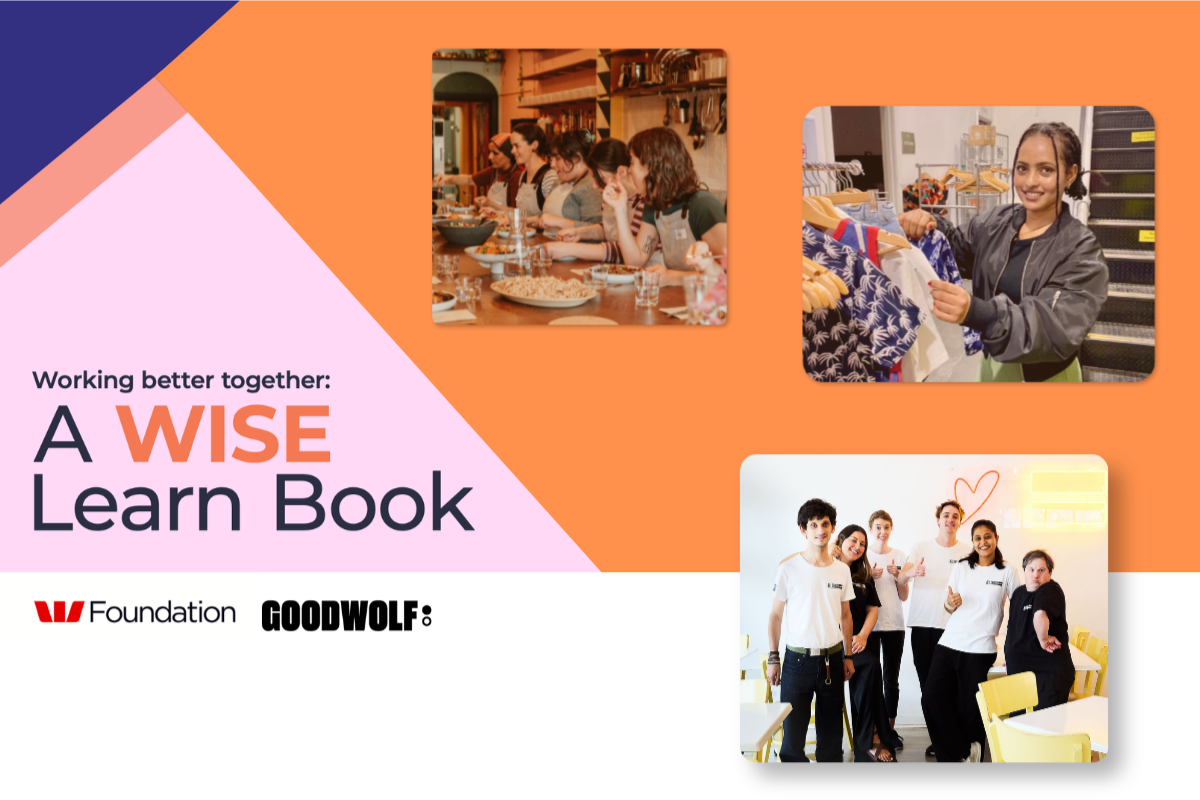
This Learn Book was commissioned by Westpac Foundation (and prepared by GoodWolf Partners), and is a practical, experience-based resource designed to support funders, practitioners, and intermediaries. Rather than offering a single model or set of answers, it opens up the real conversations, the tensions, trade-offs, and lived realities, of building and sustaining WISEs.
Why this conversation matters
WISEs play a critical role in creating pathways to employment for people who experience disadvantage. But the conditions they operate in are complex, and often misunderstood.
Across the discussion, a few key themes emerged:
1. Sustainability isn’t simple, and it isn’t static
Sustainability in WISEs is not a straight line to profitability. It shifts over time in response to the market, community needs, and the impact model itself. For many organisations, it’s about being able to deliver their work day-to-day and having the resilience to continue into the future, not just hitting a financial benchmark.
2. Impact comes with real costs
A consistent insight was that the “true cost of impact” is often underestimated. For most WISEs, income from trade alone is unlikely to fully cover these costs. This creates ongoing tension between financial expectations and delivering meaningful outcomes.
3. Funding shapes the sector
Philanthropy and funding models don’t just support WISEs, they influence which models grow, what success looks like, and whose voices are heard. Short-term funding, narrow metrics (like job targets), and pressure to scale can unintentionally distort decision-making.
4. Growth should follow demand, not pressure
WISE leaders shared the importance of growing in response to real demand, rather than expectations from funders or the broader ecosystem. Scaling impact doesn’t always mean scaling the organisation; it can also happen through partnerships, networks, and different models of delivery.
5. Honest conversations about risk are essential
There is often a gap between how risk is discussed and how it’s experienced. Both funders and practitioners highlighted the need for more open, realistic conversations about challenges, uncertainty, and failure, not just success.
6. The system around WISEs needs to evolve
While WISEs deliver strong employment and social outcomes, they are not consistently supported by policy, funding structures, or shared data. There is a clear opportunity for more coordinated advocacy, better evidence, and stronger alignment between philanthropy and government.
What this resource offers
This webinar is part of a broader effort to share practical insights with the sector, not as a definitive guide, but as a starting point for deeper conversation.
It brings together:
- Reflections from funders, intermediaries, and WISE leaders
- Real-world examples of what works (and what doesn’t)
- Honest perspectives on sustainability, scaling, and impact
A key message from the session is that there is no single model for success in WISEs. Different organisations, communities, and contexts require different approaches.
Show notes and quotes
Alexie Seller: "Sustainability, as it comes to me as a practitioner experiencing the conversation with funders, is almost a proxy for talking about risk. We could just have the conversation about risk instead."
Sally Quinn: "The day-to-day is the primary experience of being sustainable - being able to do the day's work without having to change priorities because there's a crisis we're managing, often around cash flow."
Jess Moore: "WISEs provide a service for which they're not currently paid. They run businesses, often selling into the market, but they are not paid for the contributions they make around employment outcomes. That has to change."
Loretta Bolotin: "Fear of failure is holding back honest conversations about risk and truly unlocking the role of risk capital."
Nina Yousefpour: “There is a gap between the expectations and reality in how WISEs are funded and supported. This resource comes at the right time to speak to many of those learnings."
Sally McGeoch: "It's a really important part of changing systems, I think, as philanthropy: To turn the mirror on your own practices and mindsets, listen deeply to those at the front lines of the sector, and be honest with each other about what it really takes to create impact together."
Lisa Waldron: "Funding alone is never the full story."
Explore more
-1.png)
We’d love to hear from you!
Understorey is shaped by the people and organisations across Australia. Have suggestions, ideas or resources to share? Get in touch and help us make Understorey more useful, relevant and accessible for everyone.
Get in touch