28 Apr 2026
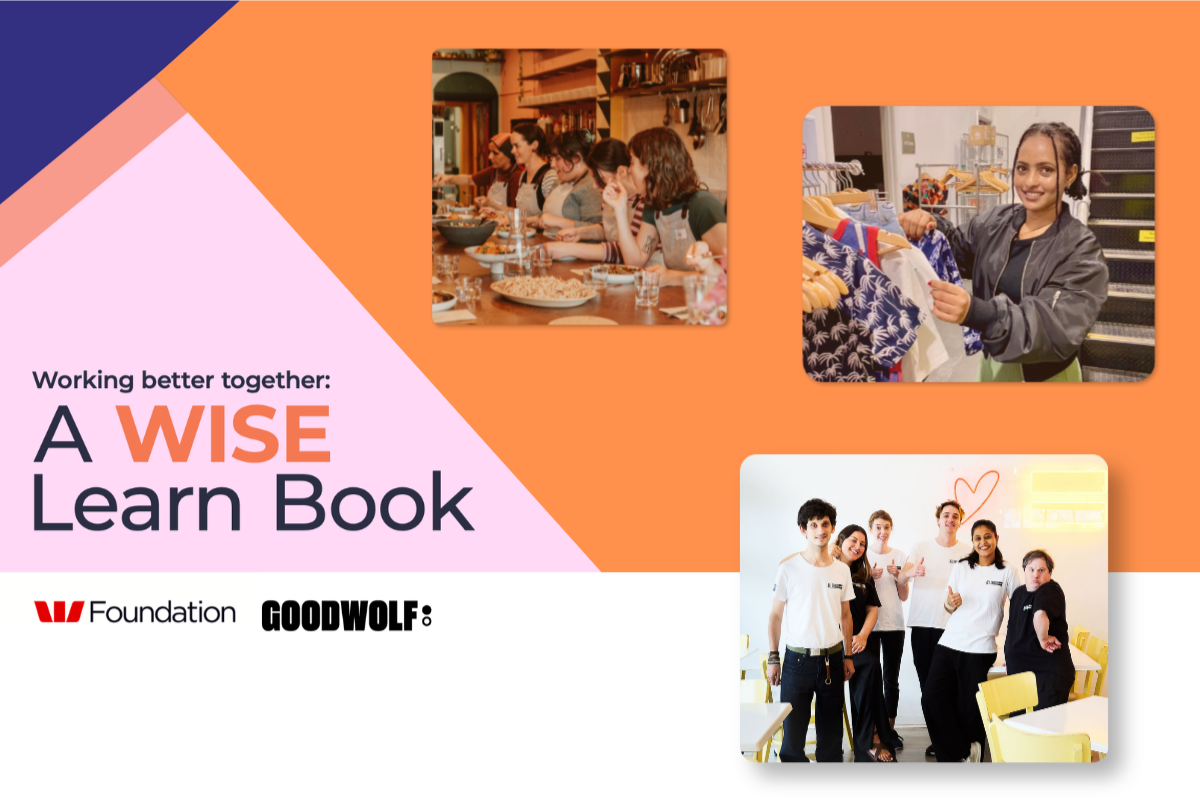
Working better together: A WISE Learn Book
By GoodWolf Partners for Westpac Foundation
Two decades of funding Work Integration Social Enterprises taught Westpac Foundation hard lessons about impact costs, sustainability, scaling, and philanthropy's role. This summary of their 2026 Learn Book distils those insights for WISEs, funders, and sector intermediaries across Australia.
Summary
This Learn Book was commissioned by Westpac Foundation (and prepared by GoodWolf Partners) to mark the close of its 20-year strategic focus on Work Integration Social Enterprises (WISEs). Over that period, the Foundation invested $34.7 million directly in 89 social enterprises and helped partners create more than 11,970 jobs for people facing complex barriers to employment, surpassing its target of 10,000 jobs by 2030.
The Learn Book was developed through a participatory process that engaged a WISE Advisory Group, a Funders and Supporters Advisory Group, five in-depth case study organisations, and a sector-wide survey. It draws on practitioner voices throughout, grounding its insights in real operational experience.
This summary covers the key ideas and learnings from the full resource, written for practitioners, funders, intermediaries and advocates working across the Australian social enterprise ecosystem.
What is a WISE?
A Work Integration Social Enterprise (WISE) is a social enterprise whose primary purpose is creating meaningful employment opportunities for people who face complex barriers to work. These barriers might include disability, refugee or asylum seeker status, involvement with the justice system, experiences of domestic violence, long-term unemployment, or other forms of entrenched disadvantage.
WISEs are not a single model. They sit on a spectrum:
- Transitional (supply-side) models support people to build skills and confidence before moving into mainstream employment. A trade-off exists here: WISEs lose their most capable employees just as they hit their stride, requiring constant re-recruitment and re-training.
- Destination (demand-side) models retain trained employees within the enterprise for the long term. These are particularly relevant in regional and place-based contexts where mainstream employment pathways may not exist.
- Hybrid models blend both approaches, often using structured short-term programs alongside longer-term employment opportunities.
A common misconception is that a job in a social enterprise is not a 'real' job. This framing leads to an over-emphasis on transitional models. In reality, destination employment, paid, skilled, and productive, is a valid and often vital outcome in its own right.
WISEs also operate across a wide range of industries, including hospitality, fashion, construction, horticulture, commercial laundry, and data analytics. They may be structured as not-for-profits, incorporated associations, for-profit hybrids, or co-operatives. There is no single legal form.
A defining characteristic of all WISEs, regardless of model, is the wrap-around support they provide: bespoke, holistic assistance tailored to the needs of their cohort. This might include physical workplace adjustments, financial literacy training, trauma-informed supervision, language and cultural support, or referrals to mental health and housing services.
The impact WISEs deliver
WISEs generate significant public value, for individuals, families, communities, and government. Evidence suggests individual WISEs can outperform mainstream employment services across several indicators, including:
- mental health and wellbeing
- employability and work readiness
- job retention and earnings
- housing stability
- broader social and economic outcomes
A Payment by Outcomes (PBO) Trial run by White Box Enterprises found that 82% of WISE participants remained employed at the 26-week mark. By comparison, 2025 data from Workforce Australia Services showed just 11.7% of participants still employed at that point. While the PBO is a smaller dataset, it illustrates the potential of the WISE model to produce more durable employment outcomes for people with barriers to work.
Understanding impact costs
One of the most important, and most misunderstood, concepts in the WISE sector is impact costs: the additional expenses WISEs incur in delivering their social purpose that mainstream, non-social-enterprise competitors do not face. These include the salaries of staff who provide job-readiness support, coaching, skills development, and referrals to external services.
Key things to understand about impact costs:
- They are predominantly variable, meaning they tend to increase, not decrease, as a WISE grows and serves more people. This means growth does not automatically improve financial sustainability; it can constrain it.
- They are specific to each WISE. While 30-35% of overall costs is sometimes cited as a rough figure, this is not research-supported and can be misleading. Impact costs are shaped by the cohort being served, the revenue model, the industry, and the geography.
- They create an 'impact cost gap'. For most WISEs, especially in highly competitive markets, trade income alone is unlikely to cover the full cost of delivering employment outcomes. In Australia, where government policy does not routinely address this gap, philanthropy has largely filled it.
- They do not diminish with time or scale. As one WISE practitioner put it: 'As impact scaled, those costs also increased. Philanthropic reliance didn't taper over time, it grew alongside delivery.'
The biggest myth in the sector, named clearly by practitioners, is the belief that WISEs will eventually be able to fund their impact costs through trade. Trade is a platform for delivering employment outcomes, not a mechanism for covering the cost of inclusion.
Westpac Foundation has contributed to the development of an impact costs methodology and calculator tool in partnership with the Centre for Social Purpose Organisations at Melbourne Business School. A free online tool for WISEs to calculate their own impact costs will be available soon.
Sustainability, business models, and margins
There is no universal definition of financial sustainability in a WISE context, and the sector's persistent confusion on this point is limiting its maturity and alignment with funders.
For WISEs, sustainability is better understood as mission continuity, the ability to plan ahead, maintain a diverse revenue base, and keep delivering impact, rather than profitability or independence from philanthropic support.
WISEs typically draw on a blend of income streams:
- Trade income (goods and services sold commercially)
- Philanthropy and corporate partnerships
- Government incentives
- Working capital (to manage cash flow across payment cycles)
Where a WISE sits on the spectrum from charity-oriented to commercially oriented depends on its mission, cohort, geographic context, and the degree to which the market can realistically cover its costs. All models are purpose-driven and valid.
Many WISEs operate in low-margin sectors, partly because these industries tend to offer accessible entry points for people facing significant barriers to work. This limits their ability to build reserves, absorb shocks, and fund innovation. Practitioners observe that WISEs operating in emerging industries, niche markets, or cooperative models tend to show greater commercial strength.
A critical point for funders: social enterprise status does not allow WISEs to charge more. They must compete on price and quality. Underquoting to win contracts is not the answer — it erodes long-term competitiveness and masks the true cost of delivery.
The challenges of scale
Scaling is one of the most contested topics in the WISE sector. The resource identifies three distinct types of scaling for social innovation:
- Scale out: replication and expansion, increasing the number of people or communities reached
- Scale up: influencing laws, policy, and institutional change
- Scale deep: changing relationships, cultural values, and beliefs, hearts and minds
Scaling out is often the default expectation of funders and is also the highest-risk growth pathway for WISEs. New sites require management capacity, premises, systems, and local partnerships before revenue becomes predictable. Fixed costs rise quickly; trade income takes time to stabilise.
Critically, the traditional commercial assumption that unit costs fall as organisations grow does not apply to WISEs, because impact costs are variable and increase with scale. If a WISE expands the number of jobs it creates, impact costs generally grow in absolute terms, compounding, rather than solving, the impact cost gap.
The Australian Spatial Analytics (ASA) case study illustrates this clearly. Funded to expand from its Brisbane base to a national footprint, ASA reached four sites before having to close its Cairns and Adelaide offices after losing key commercial clients. The core learning: geographic expansion should be customer-driven and contract-led, not established in anticipation of demand.
By contrast, Jigsaw Australia demonstrates a 'scaling up' approach, using the success of its employment model to advocate for policy change in the disability employment system, contributing to the redesign of the Disability Employment Services (DES) program and sharing its model through partnerships with other providers, rather than replicating its own geographic footprint.
Not all WISEs aspire to scale, and not all should be expected to. For place-based and regional WISEs in particular, quality and continuity of employment outcomes may matter more than growth. Scaling is a strategic choice, not an inevitable next step.
Stages of WISE development
The resource outlines a five-stage development framework: Vision, Validation, Development, Growth, and Established; to help establish shared language between WISEs and funders, and to direct support appropriately.
Three important caveats apply:
- Development is uneven. A WISE may have a mature impact model while still needing to revisit its financial model. Stage-based classification should reflect this complexity rather than force a linear narrative.
- Full financial independence is widely considered unrealistic. Many WISEs will continue to rely on non-trade revenue to cover impact costs throughout their lives, not as a sign of failure, but as a structural feature of the model.
- The 'Growth' stage may be the final phase for many WISEs. Not every organisation will meet the criteria for 'Established', particularly those with high impact costs embedded in their model.
The role of philanthropy
The resource identifies ten key insights for funders supporting WISEs, based on two decades of learning by Westpac Foundation and its co-funders.
1. Start with impact. WISE funding does not need to sit only with specialist WISE funders. Funders focused on youth, disability, justice, or regional disadvantage are natural allies, and most are not yet funding WISEs.
2. Different funders play complementary roles. Grants, capability building, working capital, and impact investment all have a place. A healthy ecosystem relies on multiple funder roles operating in coordination.
3. Philanthropy has an ongoing, not just transitional, role. The sector needs sustained support even as it matures. Funders can also use their networks and influence to connect WISEs to new opportunities.
4. Funding preferences shape the sector. A historic emphasis on scale and transitional employment has unintentionally narrowed what 'success' looks like. Philanthropy is uniquely placed to fund resilience and impact costs, not just expansion.
5. Short-term, competitive funding creates instability. If philanthropy backs growth, it should be prepared for ongoing or multi-year support to avoid funding cliffs in volatile markets.
6. Sustainability expectations need recalibration. Pressure to demonstrate year-on-year growth and decreasing reliance on philanthropy often leads WISEs to overstate their financial position, masking real risk.
7. WISEs need flexible, multi-year support to influence systems. Short-term, rigid grants are poorly matched to the pace of systems change.
8. Plan for challenges, not just success. Funders and WISEs can agree in advance on what support would be available if growth does not meet expectations, reducing the pressure to seek help reactively at the point of crisis.
9. Get more comfortable with failure. A stronger WISE ecosystem requires a more mature relationship with risk, learning, and iteration.
10. Balance trust with proportionate due diligence. Good due diligence should strengthen WISE planning without adding burden. It should focus on a small set of fundamentals: impact intent, business model, financial risk, governance, and key partnerships.
Funding gaps across the WISE journey
WISEs face funding gaps at every stage of development, not just at start-up. Philanthropy can play a unique role in addressing gaps that government and commercial finance are not well-positioned to fill, including:
- Early-stage funding, when most funders still require evidence of impact and commercial success
- Upfront infrastructure and equipment, required to create structured, repeatable work opportunities
- Working capital, to bridge cash flow gaps when payment terms extend beyond 60 to 90 days
- Growth funding, including contingency capital for wind-back or restructure if expansion does not go to plan
- Capability building, covering governance, financial management, risk, impact measurement, and leadership wellbeing
- Impact costs, which remain an ongoing gap across all stages of WISE development
- Physical assets, given that few WISEs own their premises
Expanding the funder toolkit
Beyond traditional grants, philanthropy can deploy a range of instruments including recoverable grants, zero- or low-interest loans, program-related investments (PRIs), and loan guarantees. Australia's first WISE-specific loan fund, the Social Enterprise Loan Fund (SELF), was launched in 2025 by White Box Enterprises, providing low-cost, patient capital with impact-based interest reductions.
Systems conditions, awareness, and advocacy
Despite the evidence base for WISEs' effectiveness, the sector remains largely excluded from Australia's mainstream employment services system and mainstream capital markets. Key system-level gaps include:
- No national social enterprise strategy: Australia is still in development, and shared infrastructure and coordination remain limited compared to international markets.
- No formal recognition of WISEs as a distinct employment pathway, limiting access to sustained government funding and policy support.
- Underutilisation of government social procurement: existing tender processes tend to favour large incumbents over mission-led enterprises.
- Sector data gaps: while impact costs methodology is advancing, aggregated data on WISE outcomes across the sector is limited, weakening the case for systemic investment.
- Labour market headwinds: entry-level jobs are at risk from automation and cost pressures, increasing the difficulty of finding suitable industries that also offer adequate margins and career pathways.
- Stigma and employer perceptions continue to limit market opportunities for WISEs, particularly those supporting highly marginalised groups.
Philanthropy can play a catalytic role at the systems level: advocating with government, co-funding intermediaries, supporting procurement reform, championing outcome-based funding design, and funding place-based models in rural and remote communities where WISEs cannot access the infrastructure benefits available in cities.
Key learnings at a glance
For WISEs:
- Plan with rigour rather than pressure to scale. Model impact costs and realistic forecasts, including worst-case scenarios.
- Grow in response to confirmed demand, not in anticipation of it, and maintain financial buffers.
- Invest in strong governance, financial capability, and leadership wellbeing.
- When commercial viability and social mission are in tension, prioritising viability in the short term may be necessary to sustain long-term impact.
For funders:
- Understand that impact costs are structural and cannot usually be recovered through trade alone.
- Reframe sustainability expectations: for many WISEs, ongoing philanthropic support will always be part of the revenue mix.
- Avoid incentives that drive premature scaling. Impact can be achieved through multiple scaling strategies, not just expansion.
- Provide flexible, longer-term support. Walk alongside WISEs as they navigate complexity and volatility.
- Invest beyond programs, in governance, financial acumen, leadership, and organisational resilience.
- Plan for crisis. Agree on contingency provisions before they are needed.
At a systems level:
- WISEs need a supportive policy environment and formal recognition as a distinct employment pathway.
- Aggregated sector data is a gap that needs investment.
- Philanthropy has an ongoing and irreplaceable role, both in direct funding and in systems-level advocacy.
The full Learn Book, including detailed case studies and appendices, was published in April 2026 by Westpac Foundation and prepared by GoodWolf Partners on Understorey. You can find them below:
We’d love to hear from you!
Reach out to one of our team members, and share input and ideas about how we can evolve Understorey.
Get in touch